

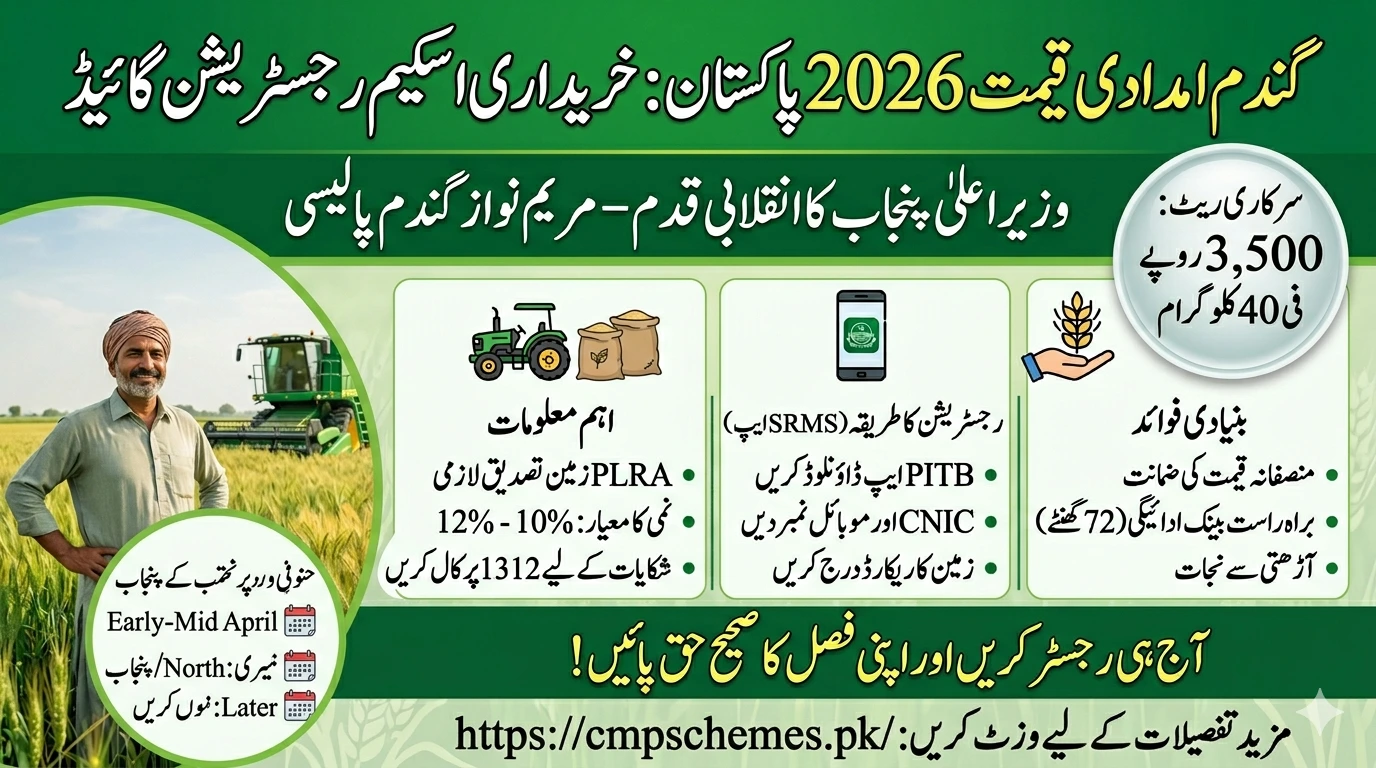
The Wheat Support Price 2026 Pakistan is a flagship initiative launched by the government to support local farmers in securing fair rates for their harvest. This wheat procurement program punjab provides a comprehensive financial safety net for deserving growers, ensuring they sell their crop with dignity and financial security. By organizing public private partnership wheat pakistan systems, the government aims to alleviate the financial burden and middleman exploitation for farmers across the province read this blog for CM Kisan Card.
As of April 2026, the program has entered its active harvest phase, with a finalized government rate and expanded coverage through digital applications.
Wheat Support Price 2026 Pakistan Full Details and Key Benefits
The maryam nawaz wheat policy is not just a buying target but a complete agricultural safety net. Each verified farmer receives a guaranteed rate designed to ease the rising costs of fertilizer and diesel for the next planting season.
Procurement Policy Summary 2026
| Benefit Category | Items Included | Estimated Value / Status |
|---|---|---|
| Support Price | Official Rate Per 40 kg | Rs. 3,500 |
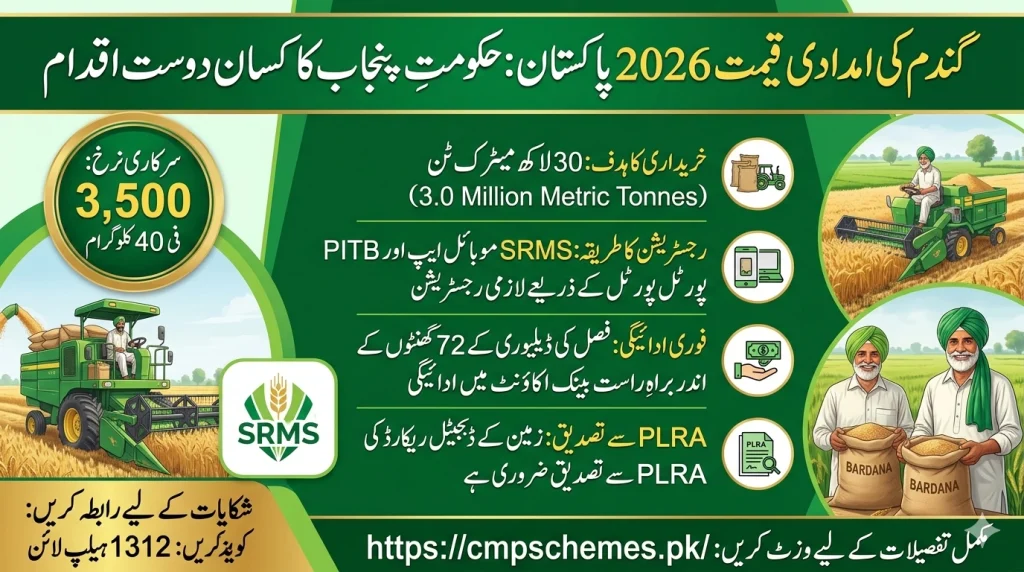
| Procurement Target | Punjab Reserve Goal | 3.0 Million Metric Tonnes |
| Buying Model | Public & Private Aggregators | Direct Farmer Payments |
| Registration System | SRMS Wheat App PITB | Mandatory for Bardana |
| Payment Timeline | Bank Transfer / Crossed Cheque | Cleared within 72 Hours |
The Rs. 3,500 Official Rate
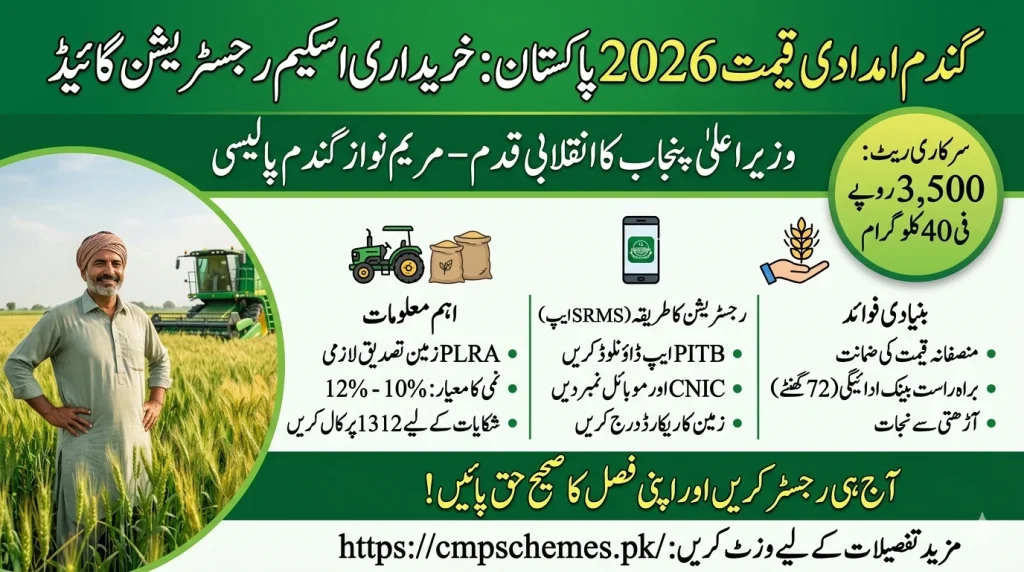
Every farmer selected for the procurement cycle receives a fixed rate of Rs. 3,500 per 40 kg. In an effort to promote fair trade, this wheat government price pakistan is disbursed directly into the farmer’s bank account, ensuring transparency and eliminating middlemen who traditionally pay less than the official rate.
Comprehensive Public-Private Partnership Model
In addition to direct government buying, the agriculture subsidy wheat pakistan schemes now utilize private sector aggregators. Out of the 3 million tonne target, 2.5 million tonnes are purchased by private companies under strict government oversight, while the food department handles the remaining 0.5 million tonnes.

PLRA Land Verification Wheat: Securing the Bardana Incentive Pakistan
In 2026, the procurement program is linked with the Digital PLRA system. Once you apply, your land ownership will be verified through the Punjab Land Records Authority digital portal. Ensure your CNIC matches the land title, as a mismatch in your data can lead to a “Registration Freeze” on your wheat bardana incentive pakistan.

Wheat Procurement Centres Punjab 2026: Quality Audits and Support
The “Middleman” Restriction
The crop payment is strictly disbursed into a single account in the verified farmer’s name. Do not attempt to provide an agent’s account or a joint account with a non-farmer. The system is hard-coded to verify the CNIC of the grower only. If the farmer does not have an active bank account, they must open one before delivering the crop.
The “Moisture Quality” Audit
The government and private aggregators strictly check crop quality to prevent sub-standard grain storage. Upon bringing your crop to the center, staff will check the moisture level. It must be between 10% and 12%. If the grain is found to be too wet or mixed with excessive debris, it will be rejected on the spot.
The “Moisture” Rejection Loophole
The Detail: Centers often reject wheat shipments if the moisture content hits 13%, failing the strict 10% to 12% requirement limit.
The Strategy: If your wheat is rejected for moisture, do not take it back to the farm immediately. Most 2026 procurement centers in Multan and Bahawalpur have designated “Drying Floors.” You are allowed to spread your wheat for 4 to 6 hours in the afternoon sun and re-request a moisture test the same evening. This simple step saves you thousands of rupees in double transport costs.
The “Bardana Logistics” Rule
The government provides gunny bags (Bardana) based on your verified acreage. The farmer is responsible for the transportation of the filled bags from their farm to the assigned wheat procurement centres punjab. Ensure you arrange a loader vehicle, as the bags must be delivered within the timeframe specified on your digital slip.
The “1312” Call Recording
Similar to other welfare programs, the 1312 helpline serves as a central complaint center. If any local official or aggregator asks for a “processing fee” or “favor” during the Bardana distribution, record the time of the incident and call 1312 immediately. The government maintains a zero-tolerance policy for corruption in the wheat scheme.
Wheat Procurement Program Punjab: 2026 Progress Milestone
By the peak of the 2026 harvest, the program aims to hit its historic target of 3.0 million metric tonnes across Punjab. The government maintains a high-transparency dashboard to monitor the progress of verified applications and daily procurement numbers. This milestone is crucial for enforcing roti price control punjab across urban areas.
Sindh Wheat Support Price 2026 and Hari Card Sindh Farmers
The 2026 phase has placed a heavy emphasis on nationwide food security. The sindh wheat support price 2026 is also set at Rs. 3,500 per 40 kg. The provincial government has integrated this with the hari card sindh farmers initiative, ensuring registered growers get priority access to buying centers and early payments. This unified approach helps stabilize the national wheat flour price pakistan.
Wheat Procurement Pakistan 2026 Eligibility Criteria
To ensure that the government support reaches genuine cultivators, the following eligibility rules apply for the 2026 harvest:
- Residency: The farmer must be a permanent resident cultivating land in the designated province.
- Target Groups: Priority is given to actual landowners and registered tenant farmers (Muzara) whose names appear in the official revenue records.
- Crop Quality: The harvested wheat must meet the standard quality, size, and moisture benchmarks.
- CRITICAL WARNING (Verified vs. Unverified Land): The 2026 guidelines are strictly for PLRA-Verified status only. If your land is not updated digitally with the Patwari, you are NOT eligible for official Bardana. This “Unverified” status is a common trap—ensure your records are clean before applying.
How to Register for Wheat Procurement Punjab via SRMS Wheat App PITB
The how to register for wheat procurement punjab guide has been simplified for 2026. Applicants can use the following step-by-step process to secure their spot:
Step 1: Access the Official App
Download the official SRMS app provided by the Punjab Information Technology Board. Create an account using your CNIC and a biometrically verified mobile number.
Step 2: Digital Form Submission
Fill in the personal details and land record information (Khewat/Khatouni numbers). You will need your CNIC and basic farm location details to allow the system to fetch your records.
Step 3: The “Patwari Verification” Stamp
During the backend process, the system uses plra land verification wheat protocols to confirm you are a legitimate grower. The government uses this verification to ensure the crop belongs to the applicant and not a proxy middleman.
Step 4: Bardana Allocation and Center Assignment
Once verified, the app issues a digital slip. This slip allocates your gunny bags and assigns you to a specific procurement center based on your tehsil, helping families plan their logistics without fear of hidden costs.
Step 5: Delivery and Payment
Deliver the wheat to the center. After the quality audit, how farmers get payment wheat policy pakistan is straightforward: funds are transferred via crossed cheque or direct online deposit within 72 hours.
How to Check Wheat Procurement Pakistan 2026 Application Status
Once your application is submitted, you can track your status through the following channels:
- Web Tracking: Log in to the official SRMS portal using your CNIC to see your current status (e.g., “Verification Pending,” “Approved,” or “Bardana Issued”).
- SMS Notifications: Successful candidates receive an automated SMS regarding their collection schedule and center location.
Regional Harvesting Timelines: South vs Central Punjab
The wheat harvest does not happen all at once. Because the weather gets hot earlier in South Punjab districts like Multan, Bahawalpur, and Rahim Yar Khan, the crop is ready to cut by early April.
The government staggers the Bardana distribution based on these zones. The SRMS app opens registration for South Punjab farmers first. If you live in Central or North Punjab, your booking window will open a few weeks later. Do not panic if the app shows your district as “Closed” in early April. The system simply waits for your local crop to mature.
| Harvesting Zone | Key Districts | App Registration & Harvest Timeline |
|---|---|---|
| South Punjab | Multan, Bahawalpur, Rahim Yar Khan | Early to Mid April |
| Central Punjab | Lahore, Faisalabad, Sahiwal | Late April to Early May |
| North Punjab | Rawalpindi, Gujranwala, Attock | Mid May Onwards |
Troubleshooting SRMS Wheat App Errors
Technology can fail during peak harvest rush when thousands of farmers try to log in. Here is how to fix the most common SRMS app problems:
- “Land Record Not Found” Error: This happens when your name in the app does not exactly match the PLRA database. Go to your local Arazi Record Center (ARC) or Patwari to make sure your CNIC is linked to your Khewat number correctly.
- OTP Not Received: The system sends a password to your phone to verify your identity. If it does not arrive, check if your mobile network is clear. Do not use a ported number (a number switched from one network to another), as these often block shortcode messages.
- App Crashing: If the app freezes, clear the cache in your phone settings or use the official web portal instead. The web portal handles heavy traffic better than the mobile app.
Handling Delayed Payments from Private Aggregators
The 2026 rule is clear: private companies must pay you within 72 hours of taking your wheat. If an aggregator delays your payment or tries to offer you less than the official Rs. 3,500 rate, you have immediate options.
First, do not hand over your original digital slip until the payment is transferred. Second, call the 1312 helpline immediately. Provide them with the name of the private buying center and your SRMS slip number. The Deputy Commissioner’s office monitors these centers daily. Any private buyer caught delaying payments risks losing their government contract and their security deposit.
Conclusion
The punjab wheat policy 2026 full details show a vital lifeline for agricultural families struggling with rising costs. By providing a fixed government rate alongside a transparent digital system, the government is fulfilling its promise to end middleman exploitation. Apply today through the SRMS app and take the first step toward a secure and profitable harvest.
Frequently Asked Questions
What is wheat support price in pakistan 2026?
The official government buying rate is set at Rs. 3,500 per 40 kg for the current harvest season across major provinces.
What is the wheat price per 40 kg in pakistan today?
While the official rate is Rs. 3,500, the open market wheat price today pakistan 40 kg fluctuates between Rs. 3,000 and Rs. 3,600 depending on daily supply and grain quality.
Where can I find the wheat procurement centres list punjab 2026?
Your specific buying center will be assigned to you dynamically through the SRMS app based on your registered land location.
Is there any application fee for Bardana?
No. The registration via the SRMS app is completely free of cost. Applicants are advised to avoid paying any money to agents or middlemen for fake slips.
What is the wheat flour price 50 kg bag pakistan 2026?
With the raw wheat price stabilized at Rs. 3,500, the 50 kg flour bag price remains strictly regulated by local market committees to ensure affordability for the public.
