

The Gilgit Baltistan Motorway Project 2026 stands as one of the most ambitious engineering feats in Pakistan’s infrastructure history. As a cornerstone of the second phase of the China-Pakistan Economic Corridor (CPEC), this project aims to transform the difficult terrain of the north into a high-speed transit corridor.
Also read this blog : Punjab Dhee Rani Program 2026
As of April 12, 2026, the National Highway Authority (NHA) has accelerated work on the feasibility and initial construction phases of the gb motorway project updates 2026, moving closer to a reality that will bypass the aging and often treacherous sections of the existing Karakoram Highway (KKH).
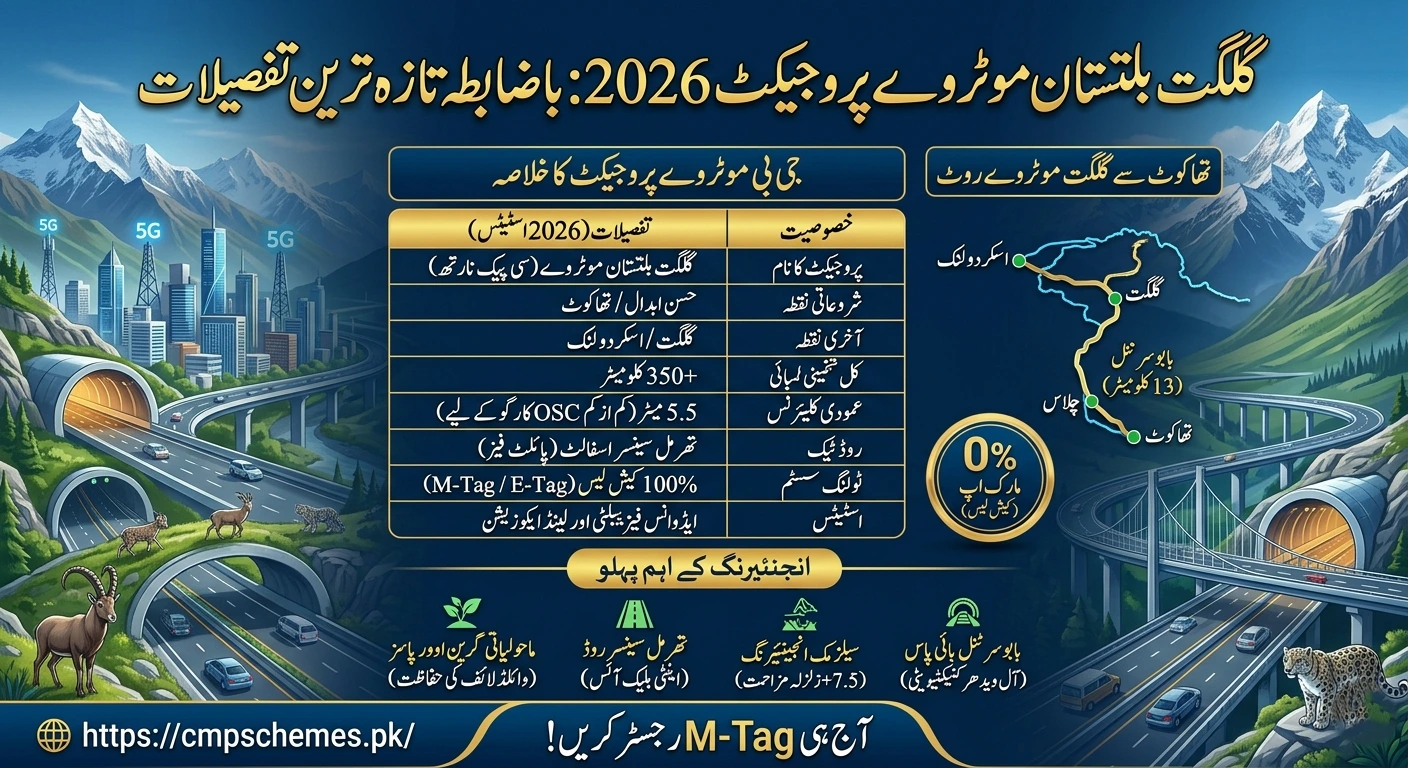
Gilgit Baltistan Motorway Project 2026: Official Overview
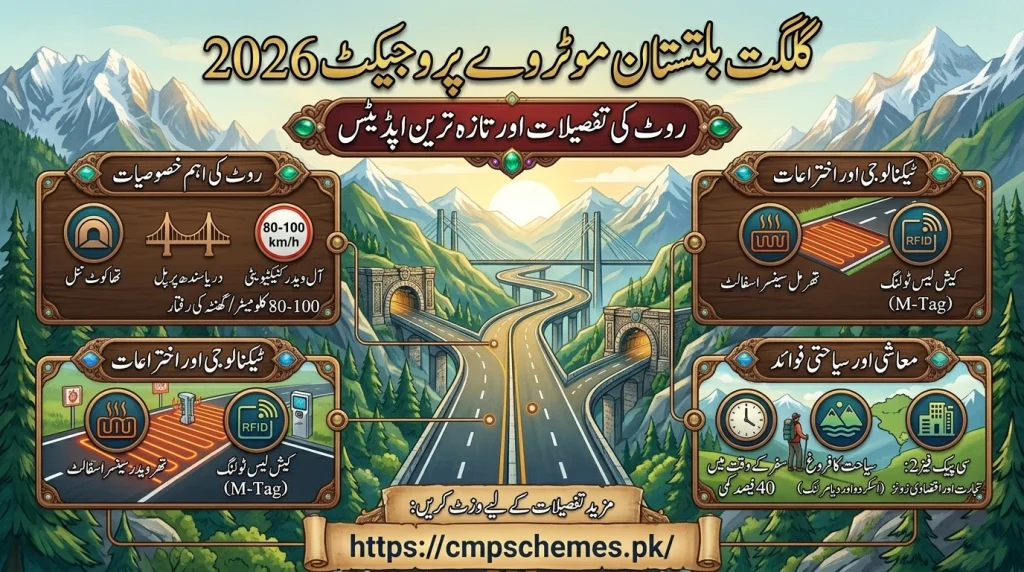
The gilgit baltistan motorway project 2026 is designed to provide an all-weather, high-speed link between the northern hubs and the national motorway network. Unlike the winding KKH, this motorway focuses on tunneling and bridging to maintain a steady speed of 80–100 km/h even in mountainous zones.
GB Motorway Project Summary Table
| Feature | Details (2026 Status) |
| Project Name | Gilgit Baltistan Motorway (CPEC North) |
| Starting Point | Hasan Abdal / Thakot |
| Ending Point | Gilgit / Skardu Link |
| Total Estimated Length | 350+ Kilometers |
| Vertical Clearance | 5.5 Meters (Minimum for OSC Cargo) |
| Road Tech | Thermal-Sensor Asphalt (Pilot Phase) |
| Tolling System | 100% Cashless (M-Tag / E-Tag) |
| Status | Advanced Feasibility & Land Acquisition |
Engineering Innovations: The 2026 “Climate-Resilient” Model
The Babusar Tunnel Strategic Bypass
While the main motorway follows the Indus River alignment, the 2026 master plan includes the Babusar Tunnel as a critical strategic link. This 13-kilometer tunnel allows the motorway network to remain operational even when the Babusar Pass is buried under 15 feet of snow. This bypass effectively transforms the hasan abdal to gilgit motorway into a true all-weather corridor, bypassing the most dangerous winter landslide zones of the Kohistan district.
Vertical Clearance for CPEC Heavy Cargo
In 2026, the tunnels are being constructed with a minimum vertical clearance of 5.5 meters. Unlike the older KKH tunnels, the GB Motorway is designed for Oversized Cargo (OSC) and high-cube shipping containers. This is a critical technical requirement for the CPEC Phase 2 trade flow, allowing specialized machinery for the Diamer-Bhasha Dam to move without stripping or disassembly.
The “Heating-Element” Asphalt Tech
In 2026, the NHA is trialing Heated Asphalt on critical 10% gradients. To prevent black ice and multi-vehicle pileups, specific segments near the Babusar Tunnel entrances are being laid with high-durability asphalt containing integrated thermal sensors. This ensures that even at -20°C, the road surface remains at a constant 2°C, eliminating the need for salt/chemicals that degrade vehicle underbodies.
Seismic Engineering for High-Magnitude Zones
Since the route passes through the “Collision Zone” of the Indian and Eurasian plates, the gilgit baltistan motorway project 2026 utilizes advanced seismic base isolation for all major bridges. These structures are designed to withstand earthquakes exceeding 7.5 magnitude, ensuring the northern areas motorway pakistan remains a lifeline during natural disasters.

The Route: Hasan Abdal to Gilgit Motorway Details
The motorway project gilgit baltistan route is strategically planned to integrate the northern areas with the existing M-1 and M-15 motorways.
Integration with the Hazara Motorway
The route begins its northern ascent from the terminus of the Hazara Motorway. The hasan abdal to gilgit motorway connection ensures that travelers from Islamabad or Lahore can reach the heart of Gilgit-Baltistan without the fatigue associated with single-track mountain roads.
Bypassing the Kohistan Bottleneck
One of the primary goals of the gb road development project is to create a route that is less susceptible to the landslides that frequently block the Indus Kohistan section of the KKH. Through the use of long-span bridges and advanced tunneling, the northern areas motorway pakistan will ensure year-round connectivity, which is vital for food security and trade in the region.

Environmental & Social Safeguards
Wildlife Connectivity & “Green” Overpasses
To mitigate habitat fragmentation for the Snow Leopard and Himalayan Ibex, the infrastructure development pakistan teams have integrated three dedicated “Green Overpasses.” These bridges are covered in native vegetation, allowing endangered wildlife to cross the motorway without human conflict.
Digital Empowerment: The Fiber-Optic Backbone
The gilgit baltistan motorway project 2026 pakistan is the first in the country to be constructed with an integrated Cross-Border Fiber Optic cable buried alongside the road. This provides 5G-ready connectivity to remote villages, directly supporting the impact of motorway on gilgit baltistan economy by enabling local freelancers and tourism startups.

Operational Logistics: The “Smart Toll” & E-Tag System
The GB Motorway will be Pakistan’s first fully cashless high-altitude road. The NHA is integrating M-Tag/E-Tag sensors at every entry and exit point. Because of the extreme weather, traditional toll plazas with manual booths are being phased out in favor of overhead sensors. Travelers must ensure their digital wallets are linked to their vehicle’s M-Tag before entering the Thakot-Chilas segment to avoid automated “Non-Payment” flags.
Strategic Importance: CPEC and China Connectivity
The gilgit baltistan motorway project pakistan is not merely a local road; it is a vital link in the pakistan china connectivity project.
Trade Route Optimization
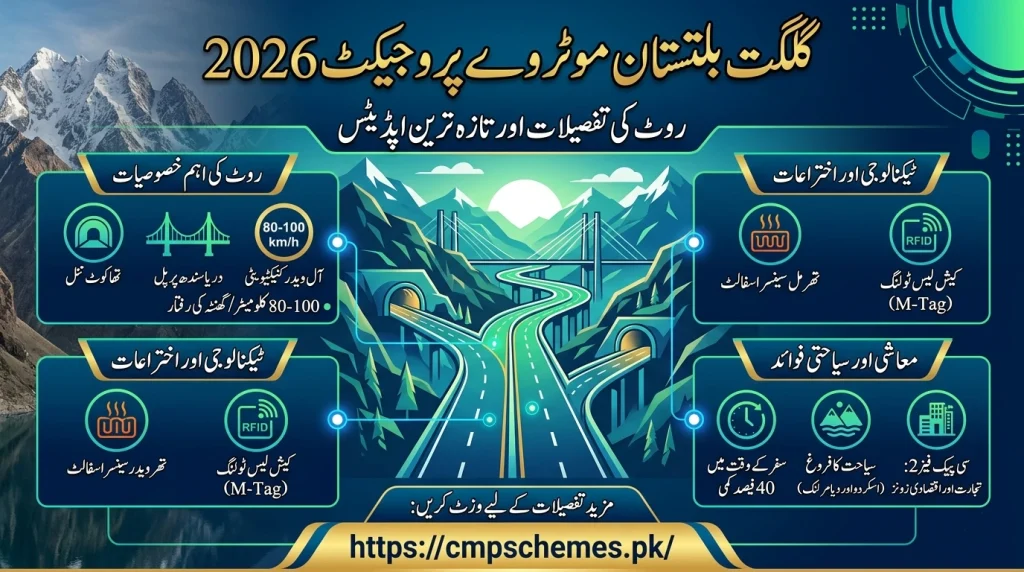
As part of the cpec motorway projects pakistan, this road will serve as the primary artery for heavy cargo moving from the Khunjerab Pass toward the ports of Gwadar and Karachi. By reducing the travel time for heavy trailers by nearly 40%, the motorway will significantly lower the cost of logistics for bilateral trade.
Economic Corridor Impact (CPEC Phase 2.0)
Beyond trade, the motorway facilitates the establishment of Special Economic Zones (SEZs). A new SEZ notified near Gilgit focuses on:
- Agro-Industrial Processing: Value-addition for cherry and apricot exports to China.
- Mineral Logistics: Centralized processing for gemstones and metallic ores.
- Eco-Tourism Clusters: Zoned areas for sustainable, high-end resort development.
Impact on Tourism and Local Economy
The benefits of gilgit baltistan motorway for tourism are perhaps the most anticipated aspect for the general public.
- Travel Time Reduction: Currently, the drive from Islamabad to Gilgit can take 14 to 18 hours. The gilgit baltistan motorway project 2026 aims to reduce this to under 8 hours.
- Tourism Development Gilgit Baltistan: Improved access will open up “virgin” tourist spots in the Diamer and Astore districts that were previously inaccessible to family vehicles.
- Winter Connectivity: Traditionally, northern areas become isolated during heavy snowfall. The construction includes snow-clearing infrastructure and heated tunnel segments to keep the route open 365 days a year.
Engineering Challenges in GB Motorway Construction
Building a motorway vs karakoram highway comparison reveals the sheer scale of the challenges in gb motorway construction pakistan.
- Extreme Topography: Constructing a 4-lane motorway through the collision zone of the Karakoram and Himalayan ranges requires world-class seismic engineering.
- Environmental Preservation: The route passes through ecologically sensitive zones. The teams are working with environmental agencies to ensure wildlife corridors are preserved through specialized overpasses.
- Logistical Constraints: Moving heavy machinery and massive bridge girders to altitudes exceeding 2,000 meters remains a significant hurdle for the pakistan infrastructure projects 2026.
Future of Northern Areas Infrastructure Pakistan
The gilgit baltistan motorway project 2026 is the first step toward a fully integrated northern transport network.
The Skardu Link
Plans are already being discussed for a 4-lane link from the main Gilgit Motorway toward Skardu, augmenting the recently upgraded Jaglot-Skardu road. This would solidify GB’s position as a global hub for mountaineering and adventure tourism.
Conclusion: A New Era for Gilgit-Baltistan
The gilgit baltistan motorway project 2026 is set to redefine the geography of Pakistan. By turning the “Wall of the North” into a gateway of prosperity, the project fulfills a decades-long dream of the people of GB. As the gb motorway project updates 2026 continue to roll out, both local residents and international investors are keeping a close eye on this transformative corridor.
Frequently Asked Questions
What is the expected completion date of the GB motorway project?
While initial phases and feasibility are targeted for 2026, the complete 4-lane corridor is a multi-year project with specific sections expected to become operational in stages between 2028 and 2030.
How is the Gilgit Baltistan motorway different from the Karakoram Highway (KKH)?
The KKH is a 2-lane road following natural contours. The Motorway (M-16/CPEC North) will be a 4-lane, controlled-access road with a much higher design speed and significantly fewer sharp curves.
Will the motorway be open during the winter?
Yes. One of the primary objectives of the gilgit baltistan motorway project pakistan is to provide “all-weather” connectivity using modern tunnel technology and advanced snow-clearing equipment.
Does the motorway project include a link to Skardu?
The main project focuses on the Hasan Abdal to Gilgit axis. However, a dedicated 4-lane expressway link to Skardu is part of the secondary phase.
What is the role of CPEC in this project?
The motorway is a primary project under CPEC’s Northern Alignment, with significant technical and financial cooperation between Pakistan and China.
How does the “Heated Asphalt” work?
In 2026, specific high-gradient segments use thermal sensors and internal elements to keep the road at 2°C. This melts ice on contact, ensuring safety during extreme snowfall without the need for manual salting.
