

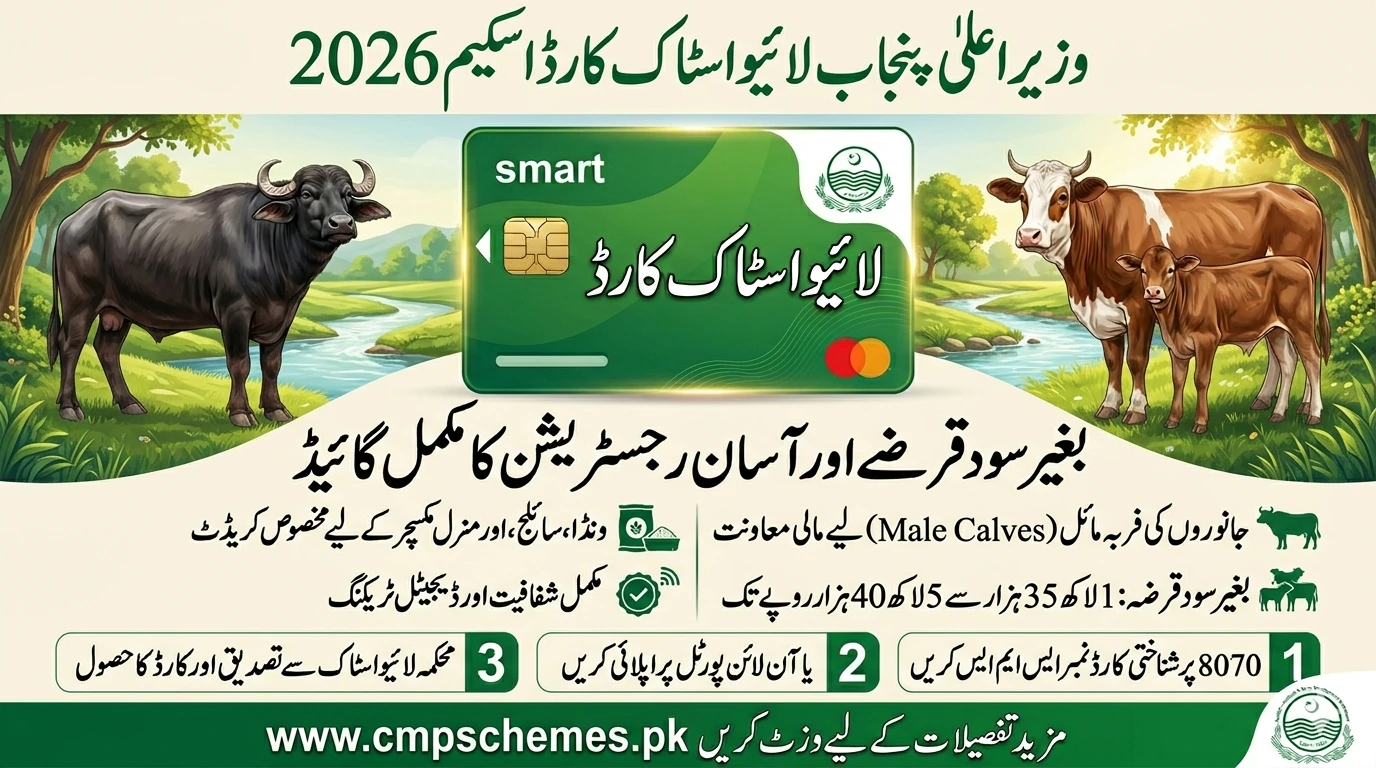
The agricultural landscape of Punjab is undergoing a massive digital transformation in 2026, driven by the Chief Minister’s initiative to integrate financial technology with traditional farming. Central to this evolution is the Punjab Livestock Card Scheme 2026. This is not merely a subsidy program; it is a fintech-driven ecosystem designed to serve as a 360-degree support system for animal nutrition, health, and farmer prosperity and also read this blog for CM Maryam Announces Rs 6 Billion Relief Package for Farmers.
As global feed prices fluctuate, the punjab livestock card scheme 2026 provides a critical financial cushion for the nation’s milk and meat producers. Managed under the Punjab Livestock and Dairy Development Department, this initiative digitizes the interest-free loan process, ensuring that taxpayers’ money translates directly into healthier herds and higher yields.
Understanding the Primary Objectives of the CM Punjab Livestock Card Scheme 2026
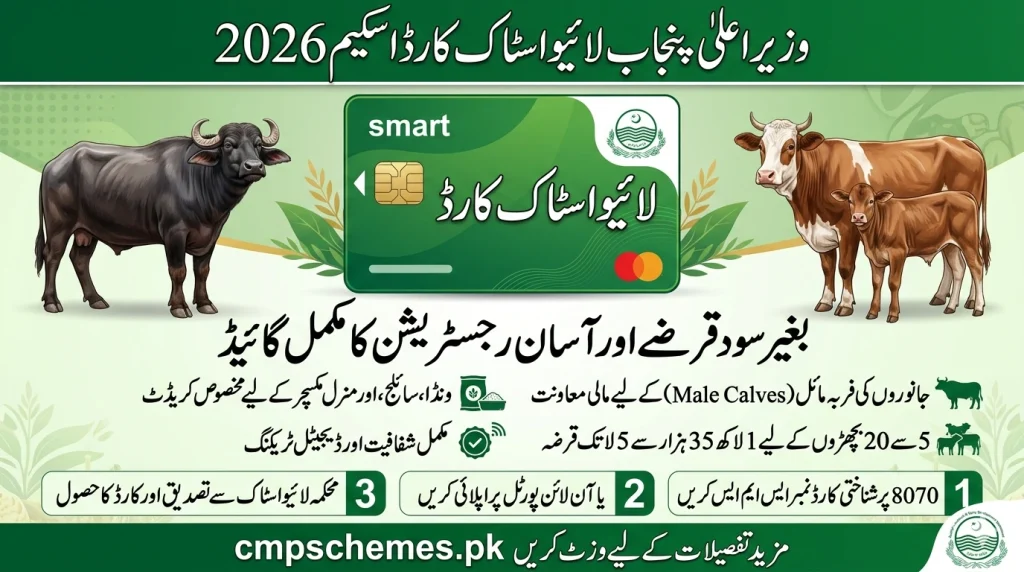
To understand what is the punjab livestock card scheme 2026, one must look at its core architecture. The platform was built to eliminate the middleman culture that previously siphoned off agricultural subsidies. By providing a digital credit line, the government ensures that funds are spent exclusively on Wanda feed, Silage, and Mineral Mixtures.
The initiative is built upon a Productivity First strategy:
- Animal Fattening: Targeted credit for male calves (cattle and buffalo) to boost meat exports.
- Nutritional Security: Direct access to verified feed dealers to prevent the use of low-quality or adulterated fodder.
- Digital Traceability: Every bag of feed purchased is tracked via the card, ensuring 100% transparency.
- Financial Inclusion: Bringing 40,000+ rural farmers into the formal banking sector for the first time.
Punjab Livestock Scheme Eligibility Criteria for Small Farmers
To ensure the benefits reach the most deserving segments, the government has established strict Punjab livestock scheme eligibility protocols. In 2026, the focus has shifted toward supporting those who actively contribute to the dairy and meat supply chains, with specific quotas for underserved regions.
Identity and Residency Requirements
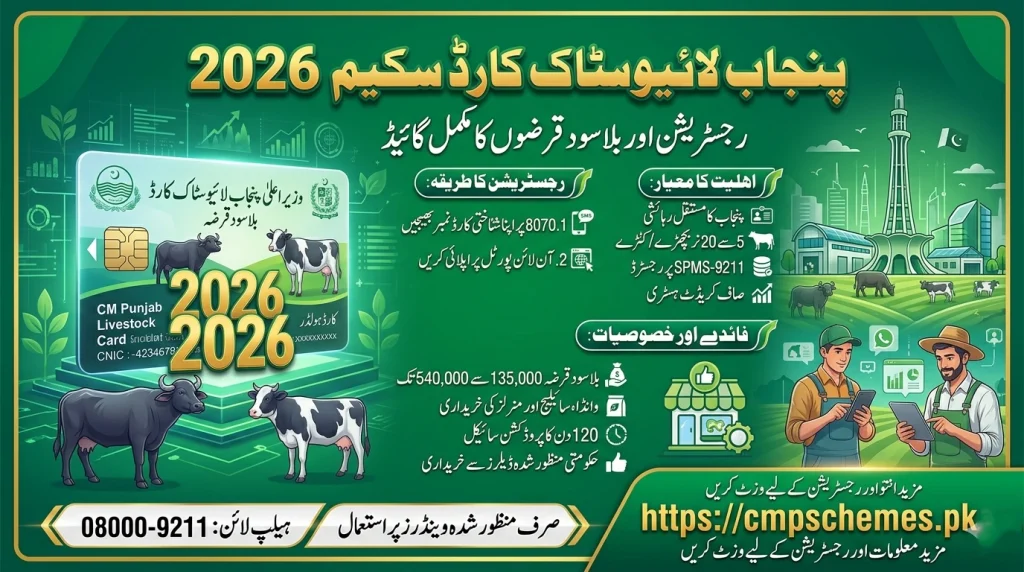
The applicant must be a permanent resident of Punjab, verified through a valid CNIC. Furthermore, the mobile SIM used for registration must be biometrically verified and registered under the same CNIC as the applicant to prevent identity theft.
Livestock Ownership Benchmarks
For Phase-II, farmers must own between 5 and 20 male calves (cattle or buffalo). Farmers with more than 20 animals are still eligible but will receive the credit facility for a maximum of 20 animals. Additionally, it is mandatory for the applicant to be registered on the SPMS-9211 database of the Livestock Department.
Financial and Security Verification
Applicants must have a clean credit history verified by the Electronic Credit Information Bureau (e-CIB), with no history of default in government schemes. Finally, all applicants undergo identification and character verification through NADRA and NACTA to ensure the security of the disbursement.

How to Apply for Punjab Livestock Card Scheme 2026 Step by Step
The livestock card registration process has been streamlined for 2026. Recognizing the diversity of Punjab’s rural population, the government has enabled both SMS-based and portal-based signup workflows.
Quick Eligibility and Requirement Matrix
| Requirement | Specification | Mandatory Document |
| Animal Count | 5 – 20 Male Calves (Buffalo/Cattle) | Departmental Verification |
| Residency | Permanent Resident of Punjab | Valid CNIC |
| Credit History | Clean (No Bank Defaults) | State Bank Clearing |
| System Linkage | Registered with SPMS-9211 | Active Mobile Number |
Method 1: Online Application via Official Portal
The digital portal is the primary route for a detailed application.
- Access the Portal: Navigate to the livestock card official portal punjab or the CM Punjab Schemes website.
- Fill the Digital Form: Enter your full name, 13-digit CNIC, and current animal inventory details.
- Upload Documents: Attach scanned copies of your CNIC and land ownership/tenancy proof for verification.
- Submit for Review: Once submitted, a local livestock officer will be assigned to conduct a physical audit of your farm.
Method 2: SMS Registration via 8070
To apply via mobile, simply type your CNIC number without dashes and send it to the shortcode 8070. This initiates an automated verification against the national database to confirm your identity and initial eligibility status.

Livestock Card Loan Amount Per Animal and Repayment Terms
In 2026, the Hub has introduced a Tiered Credit System based on the number of verified animals in your inventory. When the livestock officer performs the physical audit, they enter the animal count into the digital tablet, which automatically calculates your credit limit.
Understanding the Credit Tiers
The Standard Credit tier is optimized for farmers with 5 animals, providing a revolving credit line for one fattening cycle (120 days). On the other hand, the Max Credit tier is reserved for farmers with 10+ animals who require significant local processing power for large-scale silage storage.
Crucial Insight: Aligning your Feed Requirements on the official portal with your actual animal inventory is mandatory for the AI to approve the correct credit category for your profile.
Repayment Cycles and Grace Periods
The repayment logic is governed by a 120-day production cycle. While the loan is 100% interest-free, the system ensures discipline through an automated recovery schedule.
| Cycle Stage | Duration | Action Required |
| Disbursement | Day 1 | Credit loaded onto the Livestock Card |
| Utilization | Day 1–120 | Card swiped at authorized Wanda/Silage dealers |
| Grace Period | 30 Days | Post-cycle window to sell animals and arrange funds |
| Repayment | Day 150 | Full principal amount returned to the bank |
The Card Issuance Fee and Smart-Filter Security
For 2026, there is a nominal card issuance fee of Rs. 100 per animal. Do not pay cash to any agent for the card. The fee is automatically deducted from your initial credit limit by the bank. If you are approved for 10 animals (Rs. 270,000), your starting balance will show Rs. 269,000 after the one-time digital processing fee. Any request for out-of-pocket cash is a scam.
Merchant Category Code (MCC) Restrictions
The card is strictly “Whitelisted” for specific MCCs (Merchant Category Codes). Attempting to swipe the card at a grocery store or a petrol pump will result in an immediate permanent block of your CNIC from all Punjab Government agriculture schemes. The card’s ‘Smart-Filter’ only recognizes terminals at Registered Feed Mills and Silage Depots. Always verify the vendor’s ‘Authorized Dealer’ sticker before swiping.
Interim Weight Audits and Top-Up Rules
In 2026, the Livestock Department has introduced “Interim Weight Audits.” To unlock the second half of your credit limit for the 120-day cycle, the local livestock assistant may perform a mid-cycle weight check. Animals showing less than 700g daily weight gain may trigger a ‘Nutritional Consultation’ flag in the system, requiring you to attend a brief training at the local hospital before your card is topped up.
Benefits of Punjab Livestock Card Scheme Card 2026 for Animal Feed and Silage Support
The interest free livestock loan scheme punjab details are not just about credit; they are about profitability. By switching from traditional green fodder to balanced concentrate (Wanda), farmers can achieve significantly higher Return on Investment (ROI).
Performance Comparison: Fodder vs. Concentrates
- A calf on traditional fodder like Berseem or Chari typically gains between 300g and 450g daily.
- In contrast, card-supported Wanda and Silage can push that weight gain to nearly 1kg per day.
Registered Vendor Network and Livestock Card Official Portal Punjab Access
A unique feature of the CM Punjab livestock card scheme 2026 is the closed-loop vendor system. To prevent the misuse of funds, the card is only functional at POS terminals located in registered feed mills and government-certified depots.
Authorized Dealer Identification
Farmers should look for the CM Livestock Authorized Dealer signage at local feed mills. The card is specifically whitelisted for Wanda, Silage, and mineral mixtures at over 500+ registered private and government-certified locations.
Secure Transaction Process
The purchase process requires the vendor to swipe the card on a PITB-linked POS terminal. Crucially, the farmer must provide a thumbprint (biometric verification) to authorize the transaction. Upon completion, an instant SMS notification is sent to both parties from 8070, detailing the remaining credit balance.
Hub Hack: If a vendor refuses to accept the card or demands an illegal cash-out fee, report them immediately to the 24/7 Livestock Helpline at 08000-9211.
Livestock Card Registration via SMS 8070 and Online Troubleshooting
If you encounter technical issues during your livestock card 8070 registration, consult these guidelines for a quick resolution.
Troubleshooting Missing Census Data
If you receive a “Data Not Found” error, your animals are not registered in the SPMS-9211 Census. To resolve this, visit your local Veterinary Hospital to ensure your livestock census data is updated and synchronized with the central database.
Fixing SMS Format Errors
Many farmers face “Invalid CNIC Format” errors when texting 8070. Ensure you send only the 13 digits of your CNIC without any spaces or dashes (e.g., 35201XXXXXXXX). Any extra characters will cause the automated system to reject the request.
Handling Card and OTP Issues
If your card is declined, remember that it is only functional at CM Verified feed outlets. For “OTP Not Received” errors, avoid using ported mobile numbers; for the fastest verification, use a primary network SIM that matches your CNIC and ensures a stable network connection.
Rural Development and Livestock Financing Pakistan Regional Impact
To truly master the punjab livestock card scheme 2026, one must understand the regional deployment strategy.
- The Punjab government has divided the implementation into clusters, ensuring that rural development for Punjab farmers is not centralized in just a few cities.
- Southern Punjab, specifically districts like Multan, Bahawalpur, and Dera Ghazi Khan, are receiving prioritized hardware and POS terminal distribution due to the high density of livestock.
Conclusion: Navigating Government Livestock Programs Pakistan 2026
Understanding what is the punjab livestock card scheme 2026 is the first step toward scaling a traditional farm into a profitable commercial enterprise. In an era where digital farming is the new standard, staying disconnected from such a digital ecosystem is a massive disadvantage.
Whether you are seeking your first interest-free livestock loan or looking for technical animal health support, this card is your gateway. It represents a shift from subsistence farming to precision livestock management, placing the farmer at the center of the Pakistani agricultural dream.
Frequently Asked Questions
What is the maximum loan amount under the Punjab livestock Card Scheme 2026?
Currently, the interest-free credit limit ranges from PKR 135,000 to PKR 540,000, depending on the number of male calves (5 to 20) verified by the livestock department.
Is the loan really interest-free for the full 2026 period?
Yes. The CM Punjab Livestock Card Scheme 2026 is a Qarz-e-Hasna model. The government pays the markup to the banks on behalf of the farmer.
Can I use the card to buy medicine for my animals?
The primary focus is nutrition (Wanda and Silage). However, certain Hub-Approved vendors also provide essential mineral mixtures and supplements through the card balance.
What happens if I cannot repay the loan within 150 days?
The system is automated. Defaulting will block your CNIC from all future government livestock schemes and impact your credit score, making you ineligible for other CM initiatives like the Green Tractor Scheme.
Can women livestock farmers apply?
Absolutely. There is a dedicated quota for rural women in South Punjab to encourage women’s empowerment in the dairy and meat sectors.
Is there a registration fee?
No. The registration via 8070 and the physical processing at livestock offices are completely free. Beware of agents asking for processing fees.
